
Iran's Islamic Revolutionary Guard Corps (IRGC) asserted full control over the Strait of Hormuz, claiming two oil tankers turned back after a fire, and warned countries supporting the US against interference in the strategic waterway.

US and Iran officials have reportedly agreed to de-escalate tensions and ensure free passage through the Strait of Hormuz, with technical talks scheduled to continue. This development follows months of conflict, rising gas prices, and strained diplomatic relations, marked by recent retaliatory strikes and threats from both sides. Further discussions on Iran's nuclear program are set to take place in Qatar, highlighting ongoing diplomatic efforts despite recent volatility.

Iran has announced the closure of the Strait of Hormuz, citing Israel's continued strikes in Lebanon and alleged violations of a ceasefire agreement. This move comes as both Israel and Hezbollah accuse each other of breaching the truce, with casualties rising in southern Lebanon.

United States President Donald Trump and Iranian President Masoud Pezeshkian have virtually signed a 14-point memorandum of understanding (MoU) to end hostilities, reopen the Strait of Hormuz, and begin a 60-day negotiation process on sanctions and Iran's nuclear programme.

Iranian media reported an exchange of fire between Iranian and US forces near the Strait of Hormuz, amidst a shaky ceasefire between the two countries.

In a post on Truth Social, Trump used unusually harsh language to convey his message, reminding Tehran of his deadline to 'make a deal' or 'open the Strait'.

Iran has strongly rejected former US President Donald Trump's assertion that the Strait of Hormuz is 'NEW U.S. TERRITORY', with top officials warning that his 'delusions' would be 'corrected' and highlighting the gap between Washington's claims and its actual influence over the strategic waterway.

The US Central Command (CENTCOM) has launched extensive precision strikes across multiple Iranian military installations, deploying both one-way attack aerial and sea drones for the first time, to degrade Tehran's ability to disrupt international maritime trade in the Strait of Hormuz.

US President Donald Trump has declared an 'economic D-Day' against Iran, unveiling what he terms the 'most crushing economic operation ever taken' and warning global entities against providing any support to Tehran.

Amid ongoing tensions with the US, Iran's IRGC Navy has issued new directives restricting maritime movement through the Strait of Hormuz, allowing only civilian vessels on Iranian-designated routes and barring all military ships.

Iran has announced the reinstatement of strict military control over the Strait of Hormuz, citing US violations of previous agreements regarding maritime passage. This decision follows claims of continued American blockade of Iranian ports and a statement from former US President Trump regarding the persistence of the naval blockade until a comprehensive peace agreement is reached.
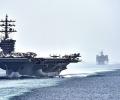
Which are the world's most vital straits, important to shipping?

Indian benchmark indices Sensex and Nifty saw declines in early trade, influenced by elevated crude oil prices stemming from renewed geopolitical uncertainties, particularly concerns surrounding the Strait of Hormuz. Track Sensex, Nifty on August 11, 2026.
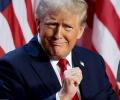
US President Donald Trump announced that a deal to end the war with Iran would be signed on Sunday, with the strategic Strait of Hormuz immediately becoming 'open to all'. This follows indications from Pakistan that negotiations were in their final stages, though Iran has yet to comment on the timeline.

Chinese Foreign Minister Wang Yi has urged Iran to guarantee freedom and safe passage through the Strait of Hormuz, a critical waterway for global oil trade, amid ongoing tensions with the US.

Donald Trump stated that Iran has been given a "last chance" to reach an agreement, revealing that the US paused a planned military strike after receiving requests from Saudi Arabia, the UAE, Qatar, and Iran to pursue diplomacy instead.

How US President Donald Trump employed a clandestine 'decoy' Air Force One operation to secretly depart Turkiye following a NATO Summit.

...reopen for up to six months. Until then, the Strait stays nearly closed. The world pays. And no one, including the man who started this, can say when it ends, notes Prem Panicker in his must read blog on the Iran War.

The US blockade on Iranian ports is aimed to curb Iranian energy exports, thereby crippling its economy to force Iran back to the negotiating table, points out Commodore Venugopal Menon (retd).

Karex, the Malaysian company that makes roughly one in five of the world's condoms -- about five billion a year, supplying Durex and Trojan among others -- announced this week that it is raising prices by up to 30 percent. The reason is the Strait of Hormuz.

US President Donald Trump jokingly referred to the Strait of Hormuz as the 'Strait of Trump' while discussing ongoing negotiations with Iran, adding that Iran was under pressure and willing to negotiate.
The Directorate General of Maritime Administration (DGMA) has instructed shipping companies to avoid deploying Indian sailors on vessels transiting the Strait of Hormuz due to the ongoing West Asia crisis, following recent attacks on two vessels carrying Indian seafarers.

Indian equities on Dalal Street saw volatility as global market trends and weak rupee impacted investor sentiment. Track Sensex, Nifty50 movement and key market drivers for May 5, 2026.

India has expressed strong concerns over attacks on commercial ships in the Strait of Hormuz, citing its importance to India's energy and economic security. Ambassador Yojna Patel highlighted the need to respect international law and ensure the safety of seafarers, while also addressing broader Middle East issues including the situation in Gaza and Lebanon.

Despite a ceasefire agreement between Iran and the United States, the Strait of Hormuz remains blocked due to Iran's inability to locate and remove all the mines it laid during the conflict, hindering global oil and gas supplies.

India is significantly expanding its crude oil sourcing to Latin America, with Venezuela emerging as a major supplier, as geopolitical disruptions in the Middle East and the Strait of Hormuz compel the world's third-largest oil consumer to diversify its energy supplies.

Supreme Leader Mojtaba Khamenei has reshuffled Iran's political and national-security establishment, appointing former SNSC Secretary Mohammad Bagher Zolghadr as his political adviser and veteran IRGC commander Mohsen Rezaei as his representative on the Supreme National Security Council, consolidating power amid the West Asia crisis and Strait of Hormuz tensions.

The US Central Command announced a new wave of strikes against Iranian military infrastructure, aiming to degrade Tehran's ability to threaten civilian mariners and commercial vessels. This comes as US President Donald Trump described the situation as a 'skirmish' and suggested Iran wants to 'make a deal,' while Iran's Foreign Minister warned of a 'decisive response' to any aggression.

Ali Mousavi stated that such cooperation is essential for maintaining stability in the strategic waterway.

'Energy prices would shoot up with the closure of Hormuz again.'

President Trump asserts the US military has decimated Iran's forces and no longer requires assistance from NATO allies to secure the Strait of Hormuz, despite earlier requests for support.

Donald Trump has warned Iran to open the Strait of Hormuz within 48 hours or face military action, escalating tensions amid regional conflict and impacting global oil supplies.

India's wholesale price index (WPI) inflation marginally eased to 9.78 per cent in July 2026, down from 9.87 per cent in June, primarily due to a cooling in the prices of fuel, power, and food items, marking the first month-on-month drop under the new 2022-23 base year.

The United States conducted retaliatory strikes against Iran, targeting over 80 sites, after accusing Tehran of attacking commercial vessels in the Strait of Hormuz, while Iran condemned the US decision to revoke a temporary suspension of sanctions on Iranian oil sales.

'Neither do the Israelis. The two attacking parties have very little economic interest in Hormuz.'

The fiscal consolidation path and Rs 1 trillion stabilisation fund provide room to absorb mild shocks, but sustained oil-price increases pose risks.

The harsh truth is that the US is no longer a reliable partner, cautions Ramesh Menon.

Despite Iran allowing 'non-hostile vessels' through the Strait of Hormuz, marine insurance premiums are expected to remain elevated due to persistent high-risk classifications and ongoing geopolitical tensions, with experts cautioning that the threat of attacks and collateral damage still exists.

Pakistan, Saudi Arabia and Turkiye on Friday signed a key joint defence agreement under which an attack against one of them will be treated as an attack against all of them, amid increasing security concerns in the wake of escalating tensions in West Asia.

Donald Trump announced he is replacing the 20% reimbursement fee for securing the Strait of Hormuz with massive trade and investment deals from Gulf States into the United States, while maintaining a full blockade on Iranian ship traffic.
